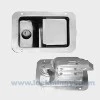
The integration of OPC UA TSN (Time-Sensitive Networking) into IIoT-enabled T-handle locks represents a transformative leap in smart factory automation. By combining the semantic interoperability of OPC UA with the deterministic communication of TSN, these locks can achieve real-time responsiveness, enhanced security, and seamless integration with broader industrial ecosystems. Below is a comprehensive guide to implementing this protocol in T-handle locks for Industry 4.0 applications.
1. Core Technical Requirements for OPC UA TSN Integration
A. Time Synchronization
Precision: TSN relies on IEEE 802.1AS for sub-microsecond synchronization across devices. For T-handle locks, this ensures timestamp accuracy for audit trails and event logging (e.g., door access attempts).
Network Hierarchy: Designate a "grandmaster clock" within the factory network to synchronize all T-handle locks, edge controllers, and PLCs.
B. Deterministic Communication
Traffic Shaping: Prioritize critical data (e.g., emergency unlock commands) over standard Ethernet traffic using TSN's Time-Aware Shaper (TAS). This guarantees low-latency transmission (<1 ms) for safety-critical operations.
Bandwidth Reservation: Allocate dedicated time slots for T-handle lock status updates to avoid packet collisions in high-density networks.
C. Semantic Interoperability
OPC UA Information Models: Embed standardized data models (e.g., device diagnostics, access permissions) into T-handle locks to enable plug-and-play integration with SCADA, MES, and ERP systems.
Unified Namespace: Use OPC UA's address space to map lock parameters (e.g., battery status, tamper alerts) into a hierarchical structure, simplifying data retrieval for predictive maintenance.
2. Implementation Steps
A. Hardware Selection
TSN-Capable Controllers: Deploy industrial-grade microcontrollers (e.g., NXP i.MX RT1180) that support TSN's 802.1Qbv (time scheduling) and 802.1Qcc (stream reservation).
Redundant Interfaces: Equip T-handle locks with dual Ethernet ports for daisy-chaining in linear or ring topologies, ensuring fault tolerance.
B. Network Architecture Design
Converged IT/OT Networks: Replace legacy fieldbus systems with a unified Ethernet backbone. For example, use OPC UA PubSub over TSN to transmit lock status data alongside video feeds from surveillance cameras.
VLAN Segmentation: Isolate T-handle lock traffic into separate VLANs to minimize latency and enhance security.
C. Protocol Mapping
Legacy Protocol Integration: For factories using Profinet or EtherNet/IP, deploy OPC UA Companion Specifications to translate existing data formats into OPC UA's semantic framework.
Edge Gateways: Use edge devices to aggregate data from non-TSN locks and bridge them into the TSN network.
D. Security Mechanisms
End-to-End Encryption: Implement AES-256 encryption for OPC UA PubSub messages to protect credentials and access logs.
Role-Based Access Control (RBAC): Define user roles (e.g., operator, maintenance) within OPC UA's security model to restrict unauthorized lock operations.
3. Key Applications in Smart Factories
A. Real-Time Access Control
Dynamic Authorization: Integrate T-handle locks with workforce management systems to grant temporary access to contractors via OPC UA's method calls.
Emergency Unlocking: Use TSN's deterministic latency to trigger immediate unlocks during safety incidents (e.g., fire alarms).
B. Predictive Maintenance
Condition Monitoring: Embed vibration sensors in locks and transmit health data via OPC UA PubSub to predict mechanical wear.
Firmware Updates: Schedule over-the-air updates during maintenance windows using TSN's reserved bandwidth.
C. Energy Efficiency
Power Management: Monitor lock battery levels via OPC UA and automate energy-saving modes during non-peak hours.
4. Challenges and Solutions
A. Mixed-Criticality Traffic
Challenge: Balancing real-time lock commands with non-critical data (e.g., firmware logs).
Solution: Deploy IEEE 802.1Qbv schedules to prioritize safety-critical traffic while allowing best-effort data during idle slots.
B. Legacy System Integration
Challenge: Retrofitting non-TSN locks into TSN networks.
Solution: Use protocol converters (e.g., Modbus TCP to OPC UA TSN gateways) to bridge legacy devices.
C. Scalability
Challenge: Managing thousands of locks in large factories.
Solution: Adopt distributed OPC UA servers at the edge to reduce central server load.
5. Future Trends
AI-Driven Anomaly Detection: Embed machine learning models in locks to detect tampering patterns using OPC UA's historical data access.
5G-TSN Convergence: Leverage 5G's ultra-reliable low-latency communication (URLLC) for wireless T-handle lock deployments in hazardous areas.